
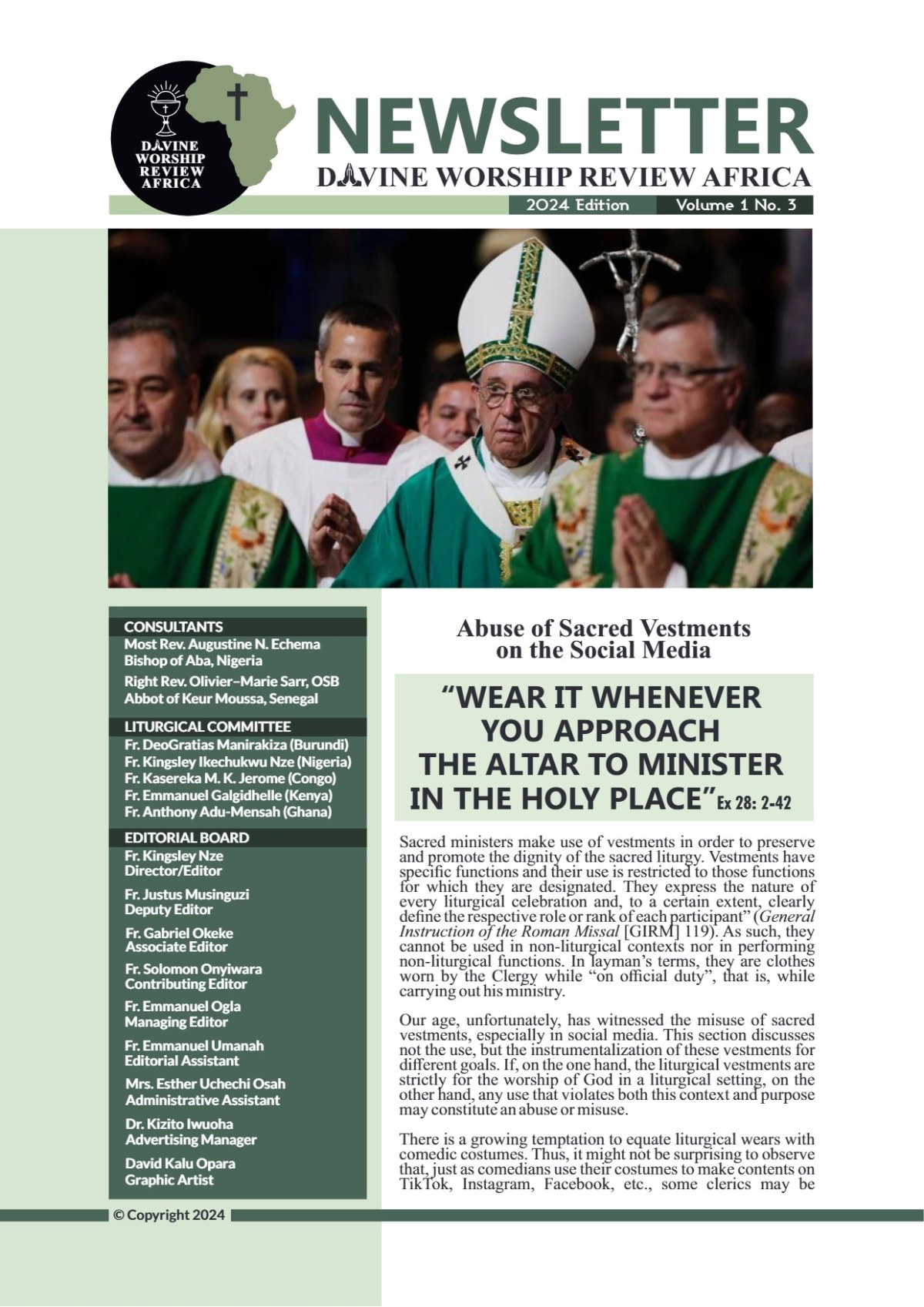
Sacred ministers make use of vestments in order to preserve and promote the dignity of the sacred liturgy. Vestments have specific functions and their use is restricted to those functions for which they are designated. They express the nature of every liturgical celebration and, to a certain extent, clearly define the respective role or rank of each participant” (General Instruction of the Roman Missal [GIRM] 119). As such, they cannot be used in non-liturgical contexts nor in performing non-liturgical functions. In layman’s terms, they are clothes worn by the Clergy while “on official duty”, that is, while carrying out his ministry.
Our age, unfortunately, has witnessed the misuse of sacred vestments, especially in social media. This section discusses not the use, but the instrumentalization of these vestments for different goals. If, on the one hand, the liturgical vestments are strictly for the worship of God in a liturgical setting, on the other hand, any use that violates both this context and purpose may constitute an abuse or misuse.
There is a growing temptation to equate liturgical wears with comedic costumes. Thus, it might not be surprising to observe that, just as comedians use their costumes to make contents on TikTok, Instagram, Facebook, etc., some clerics may be tempted to make use of their liturgical wears for the same purpose. Yet, comedy is not worship and worship cannot be comedy!
The nature and purpose of liturgical wears have been compromised in favour of a narcissistic quest for admiration in an attempt to get more likes, comments, and shares on social media, When the scope of the Liturgical vestments shifts from worship to worldly, and from sacred to profane, then materialism, vanity, and egoism are likely present. Here distinction must be made between an Ecclesiastical Habit and a Liturgical vestment. While the former refers to the clerical dress that distinguishes the clergy from the other members of the people of God, the latter is, in itself, ceremonial, and it depicts the function of the minister who uses it (cf. Canons. 284; 669§2; 929).
Without prejudice to the nobilis pulchritudo (noble beauty) of Sacrosanctum Concilium 124, there is a trend of materialism that masks itself with the expression, only the best is good enough for God. Whereas, the quest for and show-off of extravagant and “foreign” vestments, in themselves, are not geared towards the worship of God, as it is towards the projection of ego of the wearer. Their use in contents creation in the media immediately before or after the Liturgical celebration may justify this claim.
Consequently, Liturgical vestments are gradually becoming reduced to the same status of other commodities in the market. At times, the designs and colours tend to lose their symbolic meanings. The richest gets it all syndrome is finding its way into the sacred sphere; and the quality or source of one’s liturgical wears is gradually becoming a yardstick for the distinction of “rich/wealthy” clerics from the “poor” ones. Yet, decency and dignity do not necessarily depend on the price tag! Moreso, this trend may have also influenced the fabrication/customization of “individual vestments” and the projection of the vestments of a certain class of the clergy as superior and “more powerful” or “more spiritual” than others.
It is, in fact, worrisome that some clergymen relax the use of the proper liturgical vestments in the administration of the sacraments. There are modern justifications for some of these abuses. Sometimes, the weather can be used as an argument for not putting on the stole before the chasuble or omitting one or more vestments. Some others justify it with the claims of modernity, arguing that it is no longer fashionable. But Liturgical norms are not subject to private modifications (cf. Canon 838). Besides, each vestment has its own significance. Thus, “the abuse is reprobated whereby the sacred ministers celebrate Holy Mass or other rites without sacred vestments or with only a stole over the monastic cowl or the common habit of religious or ordinary clothes, contrary to the prescriptions of the liturgical books, even when there is only one minister participating” (Redemptionis Sacramentum [RS] 126). Similarly, the colours of the vestments are significant and should be respected (cf. RS 121).
Abusum non tollit usum! That there are abuses does not mean that what is right ceases to be right. And we do not correct what is wrong by normalising it. It has been observed that “many liturgical abuses are due, not to bad will, but to ignorance” (cf. RS 9). Thus, there is an urgent need to rediscover the significance and value of the Liturgical Vestments, while taking appropriate steps to curb the excesses. Aware of this need, the Catholic Bishops of Nigeria recently, in a Circular Letter to all Priests on Abuses during Liturgical Celebrations (August 15, 2024), Abuja, included the failure to use proper vestments as one of the trending liturgical aberrations in the country. Consequently, they warned:
Let it be unequivocally stated: The liturgy is not a private playground for personal innovation. It is not a platform for the self-expression of the celebrant. … We condemn, in the strongest possible terms, any and all abuses within the sacred liturgy. Such actions are not merely errors in judgement; they are violations of the sacred order and must be treated as such. We remind our priests that the altar is not a stage for theatrics, nor is the liturgy a venue for novelty. The Church has given us clear directives on how the liturgy is to be celebrated, and these must be followed without exception. Fidelity to the laws of the Church is not optional – it is mandatory.
In order to rediscover the essence of sacred vestments, it is pertinent to re-examine the prayers said before wearing these garments and the prayers said when blessing them. During the blessing of sacred vestments in Roman Ritual Book of Blessings, the minister exhorts the faithful that these articles (vestments) are to be set aside exclusively for worship (ad cultum divinum eas unice destinari). He also prays that those who wear the vestments may be prepared for the celebration of the liturgy, … wear them with reverence and honour them by the holiness of their lives.
Similarly, the vesting prayers establish the purpose of each of the vestments. Prior to vesting, while washing his hands, the priest is already conscious of his journey to Golgotha. Thus, he prays: Give strength to my hands, Lord, to wipe away every stain, so that I may be able to serve you in purity of mind and body (… ut sine pollutione mentis et corporis valeam tibi servire). At this point, the priest reminds himself that he is not going for a public show, but for the service of God and his people. Before he puts on the amice, he prays for protection from the assault of the devil (Impone, Domine, capiti meo galeam salutis, ad expugandos diabolicos incursus). As he wears his white alb (Albus), he prays for purification (Dealba me, Domine, et munda cor meum...). The wearing of the cincture too is preceded by a prayer for continence and chastity (Praecinge me, Domine, cingulo puritatis, et exstingue in lumbis meis humorem libidinis: ut maneat in me virtus continentiae et castitatis). While wearing the Stole, he prays for the authority (exousia) to celebrate the sacred mysteries (... et, quamvis indignus accedo ad tuum sacrum mysterium, merear tamen gaudium sempiterum). The priest, conscious of the weight of this sacrifice, implores the grace of God to carry this divine yoke properly as he wears the Chasuble (… fac, ut istud portare sic valeam, quod consequar tuam gratiam).
Thus, returning to the significance of these sacred garments would go a long way to reducing the abuses, especially in our world today. It would also encourage those clerics who, at times, omit some of these liturgical wears, and do not use them as required. Hence, it is pertinent to revise some basic facts about liturgical vestments, as contained in the General Instruction of the Roman Missal and Redemptionis Sacramentum. First of all, Sacred Vestments are to be blessed before using them at the liturgy (cf. GIRM, 335). While the Amice may be omitted if the Alb completely covers the inner garment, “the alb may not be replaced by a surplice, not even over a cassock, on occasions when a chasuble or dalmatic is to be worn” (RS 122; Ceremoniale Episcoporum, 65). It should be noted that the proper liturgical wear for a priest celebrant at Mass and other liturgical actions connected with it is the chasuble, worn over the alb and stole, while the deacon is to wear the dalmatic over the alb and stole (cf. GIRM, 336; Ceremoniale Episcoporum, 66, 67; Redemptionis Sacramentum, 123, 125).
On the Concelebrants, “a faculty is given in the Roman Missal for the Priest concelebrants at Mass other than the presider (who should always put on a chasuble of the prescribed colour), for a just reason such as a large number of concelebrants or a lack of vestments, to omit ‘the chasuble, using the stole over the alb” (RS 124; cf. GIRM, 209; cf. Tres abhinc Annos, 27). The norm is that concelebrants are to wear the customary vestments for the individual celebration of the Mass because each of them is, indeed, celebrating a Mass. As such, it is stated that “no one is to enter into a concelebration or to be admitted as a concelebrant once the Mass has already begun” (cf. GIRM. 206; SC. 57-58). This precludes the practice whereby some clerics, who do not concelebrate the Mass from the beginning, simply put on the stole from the beginning of the liturgy of the Eucharist and join in the consecration. The Mass does not begin at the Liturgy of the Eucharist; it is either you are concelebrating from the beginning or you are not concelebrating at all.
Since these vestments also add decorum and dignity to the liturgy, it goes without saying that their cleanliness should be superlative. Thus, care should be taken to ensure that the sacredness of these vestments is maintained and that their value is preserved.
Liturgical vestments have their nature and functions. Using them for purposes different from worship, constitutes abuse. Thus, the use of liturgical vestments in creating social content in the media is to be discouraged. This, however, does not prevent the keeping/sharing of memories of “real” worship, albeit with moderation and discretion. It does not deny the fact that the Church is to make use of the media for evangelisation (cf. Inter Mirifica, 2). In fact, evangelisation of/in the social media is obtainable even without the abuse of sacred vestments. These abuses or aberrations, rather than propagating the Gospel, may end up causing more damage to the faith.
Emmanuel Isidore Umanah is a priest of the Catholic Diocese of Ikot Ekpene in Nigeria. He holds a Licentiate in Canon Law from the Pontificia Università Urbaniana in Rome, where he is currently carrying out his doctoral research. He served as Master of Ceremonies in the Major Seminary of the Congregation for the Evangelisation of Peoples in Rome (2015-2019), and currently as the Master of Ceremonies in the Pontificio Collegio San Pietro of the Dicastery for Evangelisation in Rome. Fr. Umanah is the Editor of the Ami Ndi Eyen Katolik Series, a monthly reflection on traditional Catholic Hymns in the Efik Hymn Book, published in the Pax Newsletter of the Catholic Diocese of Ikot Ekpene, Nigeria.