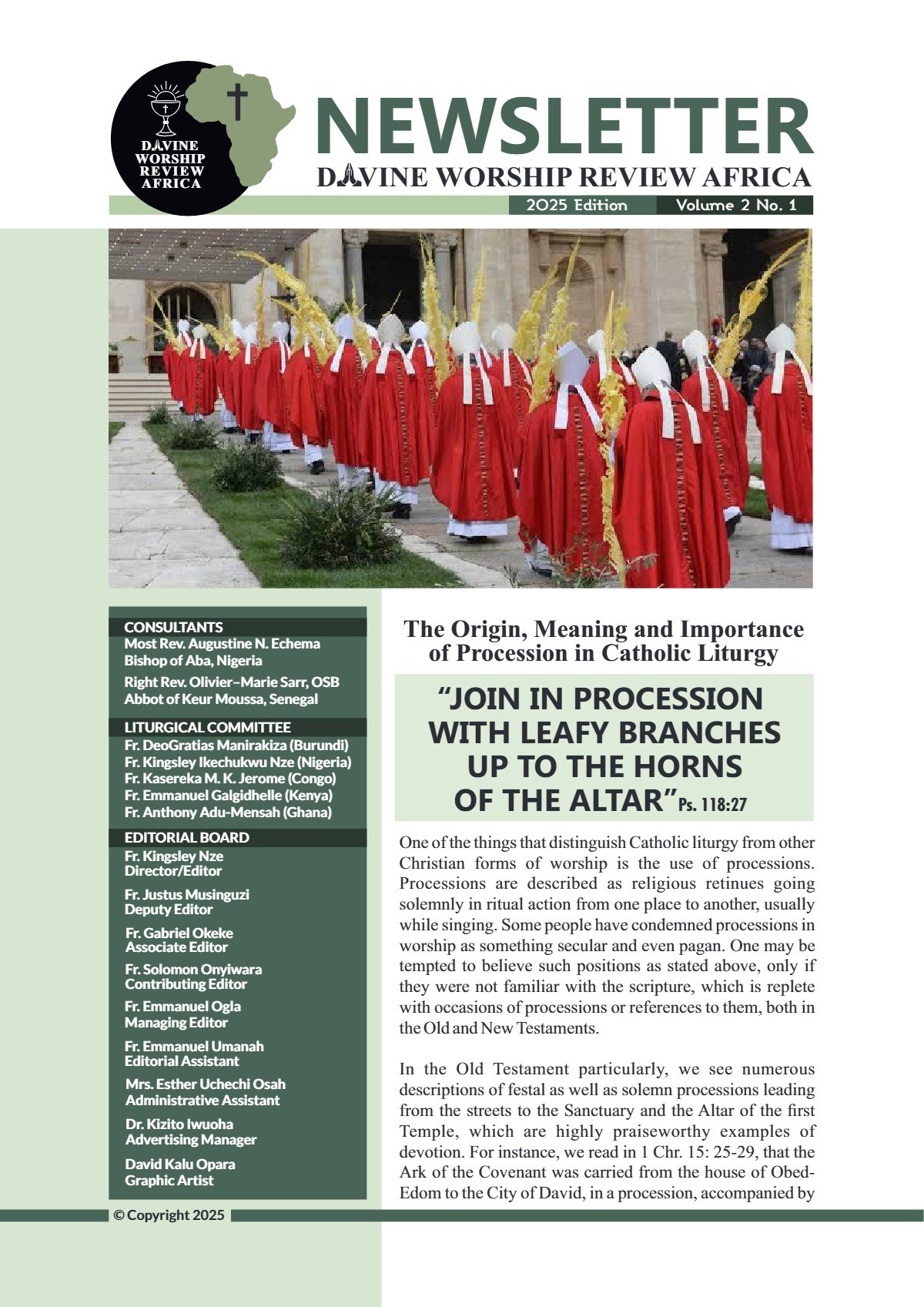
One of the things that distinguish Catholic liturgy from other Christian forms of worship is the use of processions. Processions are described as religious retinues going solemnly in ritual action from one place to another, usually while singing. Some people have condemned processions in worship as something secular and even pagan. One may be tempted to believe such positions as stated above, only if they were not familiar with the scripture, which is replete with occasions of processions or references to them, both in the Old and New Testaments.
In the Old Testament particularly, we see numerous descriptions of festal as well as solemn processions leading from the streets to the Sanctuary and the Altar of the first Temple, which are highly praiseworthy examples of devotion. For instance, we read in 1 Chr. 15: 25-29, that the Ark of the Covenant was carried from the house of Obed-Edom to the City of David, in a procession, accompanied by joyful shouts, songs and music. This Ark contained the two tablets on which the Ten Commandments were written.
We also read in 1 Kgs. 8:1-13, how King Solomon assembled the elders of Israel in Jerusalem, to bring up the Ark of the Lord from the City of David, in Zion. The King and the entire community of Israel, gathered for the occasion before the Ark, sacrificed many sheep and oxen, as the Ark was carried in procession to its place.
We hear the Psalmist say: “I remember all this - how I used to lead the faithful in procession to the house of God, amid shouts of joy and thanksgiving, among the festive multitude” (Ps. 42:4). This clearly brings out the joyful character of processions.
We also read in psalm 68:24: “I remember the procession of my God, as they came into the sanctuary: the singers in front, the musicians last, between them maidens playing tambourines”.
In the New Testament, the most explicit mention of procession is that of the triumphant entry of Jesus into Jerusalem. Here, Jesus was in the centre of the procession, as the text says: “The crowds preceding him (Jesus) and those following kept crying out and saying: ‘Hosanna to the Son of David; blessed is he who comes in the name of the Lord; hosanna in the highest’” (Matt. 21:9). Although Jesus’ procession into Jerusalem was a fulfilment of the Old Testament prophecy in Zechariah 9:9, it revealed his identity as a king and his connection to the Davidic royalty.
The above citations prefigure processions in the Catholic liturgy, which culminate at the altar where the Priest, like the High Priest of old, offers the sacrifice of the Mass - the Paschal Lamb - to the Father.
There are basically two types of processions: functional and ordinary processions.
Functional processions are those processions which constitute the elements of a given ritual structure. They are also known as ritual or ceremonial processions. We find them mainly at liturgical celebrations, for instance at Mass. In the Ordo Missae, the functional processions include:
- The opening/entrance procession: this recalls Jesus’ triumphant entry into Jerusalem, to embrace his passion, which led to our salvation. This procession is often led by the cross bearer, signifying our witness to the Cross - the standard of our salvation. It is a sign of triumph for us, and a reminder of our own Christian pilgrimage from this life to eternal life.
- The procession with the book of the gospels (at the liturgy of the Word): during the gospel acclamation, the deacon or priest (in the absence of a deacon) takes the book of the gospel from the altar and carries it solemnly to the lectern (G.I.R.M. 133, 175). This is considered as the high point of the liturgy of the Word, as the people rise and outwardly demonstrate their love and admiration for Jesus who comes to them in the Gospel. The acolytes carrying candles in procession, represent the people, as the lighted candles symbolize Christ the light of the world.
- At the presentation of gifts (liturgy of the Eucharist): it is recommended that the faithful process to the altar, presenting bread and wine at Mass, which are received by the priest or deacon, and taken to the altar. This is important because of the spiritual significance it carries (G.I.R.M 73).
- The communion procession (Communion rite): the communion procession is one procession at Mass in which the entire assembly can participate both physically and spiritually. It is usually accompanied by songs or psalms, which demonstrates that fact that we go to acclaim Jesus in the Eucharist, as he comes to us in a special presence. Here, the communitarian nature of procession is also brought out (G.I.R.M. 86).
- Recessional procession (Concluding rite): technically speaking, the closing procession is not listed in the G.I.R.M., because the Mass ends with the dismissal. However, since we are invited to “go” (that is, “sent on mission”), procession at the end of Mass has become customary and is appropriate. In the Middle Ages, various texts were used to accompany the recession of the priest, but in time, it became necessary for the choir and assembly to sing as the ministers left the sanctuary.
Within the context of the Mass, we see nowadays, the procession of clerics to the altar (as “Thanksgiving”), particularly, during ordinations, anniversaries and even birthday celebrations. It is really difficult to qualify such actions, as well as describe their liturgical significance, especially as the IGMR 2002 always makes a distinction between the ministerial priesthood and the common priesthood of the baptized. It is important to understand the liturgical significance of every action carried out in the celebration of the liturgy.
Other functional processions include Baptismal procession of the celebrant and the family of the candidates for baptism, from the entrance of the Church to the place of the celebration of the rite, during which a psalm or a song is sung. This procession has a significance of the one to be baptized, moving from the region of darkness into light, and from realm of death into the realm of life.
At Christian funerals, there are also functional processions which involve the transfer of the body to the Church and to the place of committal. This brings out the nature of the faithful as pilgrims, and of the departed, as on transition from this world to the next.
The ordinary processions are those processions established in the liturgical books or by Church custom for use during the course of the liturgical year. They include those on the Feast of the Presentation of the Lord or Candlemas day (2nd February), Palm/Passion Sunday, Holy Thursday (transfer of the Most Blessed Sacrament), Easter Vigil (at the Lucernarium), Corpus Christi (and in some regions, Christ the King). The last of the aforementioned processions has a special importance for the pastoral life of a parish, as the faithful join in songs walking through the streets, while Eucharistic blessing is given at various stations. This gives an opportunity for a public witness of the faith and devotion towards the Blessed Sacrament.
Furthermore, since Mary, the vessel that contained and bore the Lord, is referred to as the Ark of the New Covenant, the faithful are encouraged to carry her in procession to the House of God. This accounts for the traditional May and October processions in honour of the Blessed Virgin Mary.
It remains a fact therefore that, not only do processions have a biblical origin, but they also are an ancient form of popular piety that accompany the sacramental life of the Church. As we read in CCC. 1679: “In addition to liturgy, Christian life is nourished by various forms of popular piety, rooted in different cultures. While carefully clarifying them in the light of the faith, the Church fosters the forms of popular piety that express an evangelical instinct and a human wisdom, and that enrich the Christian life”.
Processions are thus a public homage to God, giving honour to him through Christ, and to his Mother, the Theotokos. Christians are then encouraged to understand the importance of processions, as open profession of our faith, and more so, as it portrays us as pilgrims through the streets of this world, heading to our eternal home in heaven.