All religions express truth about divine realities through symbols and signs to facilitate our relationship with God. Symbols and signs enable oneself to transcend from the visible–material–human realities to the invisible–immaterial–divine realities. Signs and symbols occupy a significant place in human life. Man needs signs and symbols (language, gestures and actions) to communicate with one another (Catechism of the Catholic Church [CCC] 1146).
From the observation of a great sacramental theologian, Louis–Marie Chauvet in his book, Symbol and Sacrament, “Signs and Symbols” are always mixed together in the concrete world such that it is impossible to say unilaterally that this object is a sign and that object is a symbol” (Chauvet, 1995). Writing in his “Le discours et le symbole”, Edmond Ortigues, a psychoanalytic philosopher maintained that a symbol can be distinguished from a sign since “the symbol does not refer, as does the sign, to something of another order than itself; rather, its function is to introduce us into an order to which it belongs, an order presupposed to be an order of meaning in its radical otherness” (Ortigues, 1962).
Consequently, symbols have single, simple and defined meaning whereas signs have multiple interpretations. The duo (symbols and signs) do not stand for kinds of images rather they describe the functions fulfilled by images. For instance, the image of a triangle could be a symbol of hierarchy or a sign of danger or mountain.
Following its root in the Latin word “imitari, an image has the ability to copy or imitate”. An image is the visual representation or general impression of an object, scene, person or abstraction produced on a surface or stored in electronic form. It is judged by how realistically it captures the person or the thing they represent. The idea of image is understood in many ways. Images can be in various forms – portraits, photographs, graphics, paintings, digital illustration, individual, video frames carving, and sculptures.
Many Christians are disturbed by the way Catholics venerate the images used in Christian liturgical worship irrespective of the divine injunction in Deuteronomy 5:9, where God said concerning idols, “You shall not bow down to them.” This commandment condemns polytheism and the manufacture of images in the heavens above, below the earth or beneath the waters (cf. Ex. 20:4–6; Dt. 5:8-10; Lev. 26:1; Lev. 19:4; Ezekiel 41:17–18; Ex. 20:3, Dt. 4:15–18).
The fear is that such representation might end up in idolatry (just as it happened with the story of the golden calf in Exodus 32). According to the Catechism of the Catholic Church, “Idolatry consists in divinizing what is not God. Man commits idolatry whenever he honours and reveres a creature in place of God, whether this be gods or demons (for example, Satanism), power, pleasure, race, ancestors, the state, money etc… Idolatry rejects the unique Lordship of God; it is therefore incompatible with communion with God” (CCC 2113). It is reasonable that God has to prohibit any attempt to represent Him in any artistic form since He has made His face totally unknown to his people.
There are circumstances in the Old Testament where the Lord permitted and commanded the making of statues like the cherubim, the bronze serpent and the ark of the covenant (Ex. 25:10–22; 1 Chr. 28:18–19; Num. 21:4–9; Wis. 16:5-14; Jn 3:14-15; cf. 1 Kgs. 6:23–32, 1 Kgs 7:23-26; 1Kgs. 8:6–66; 2 Chr. 3:7–14). From here, we observed that mysterious beings can be Re-Presented by material realities. This inspired the seventh Ecumenical Council of Nicaea, which in 787 allowed the veneration of sacred images as against the Synod of Elvira that prohibited the exhibition of images in the Church.
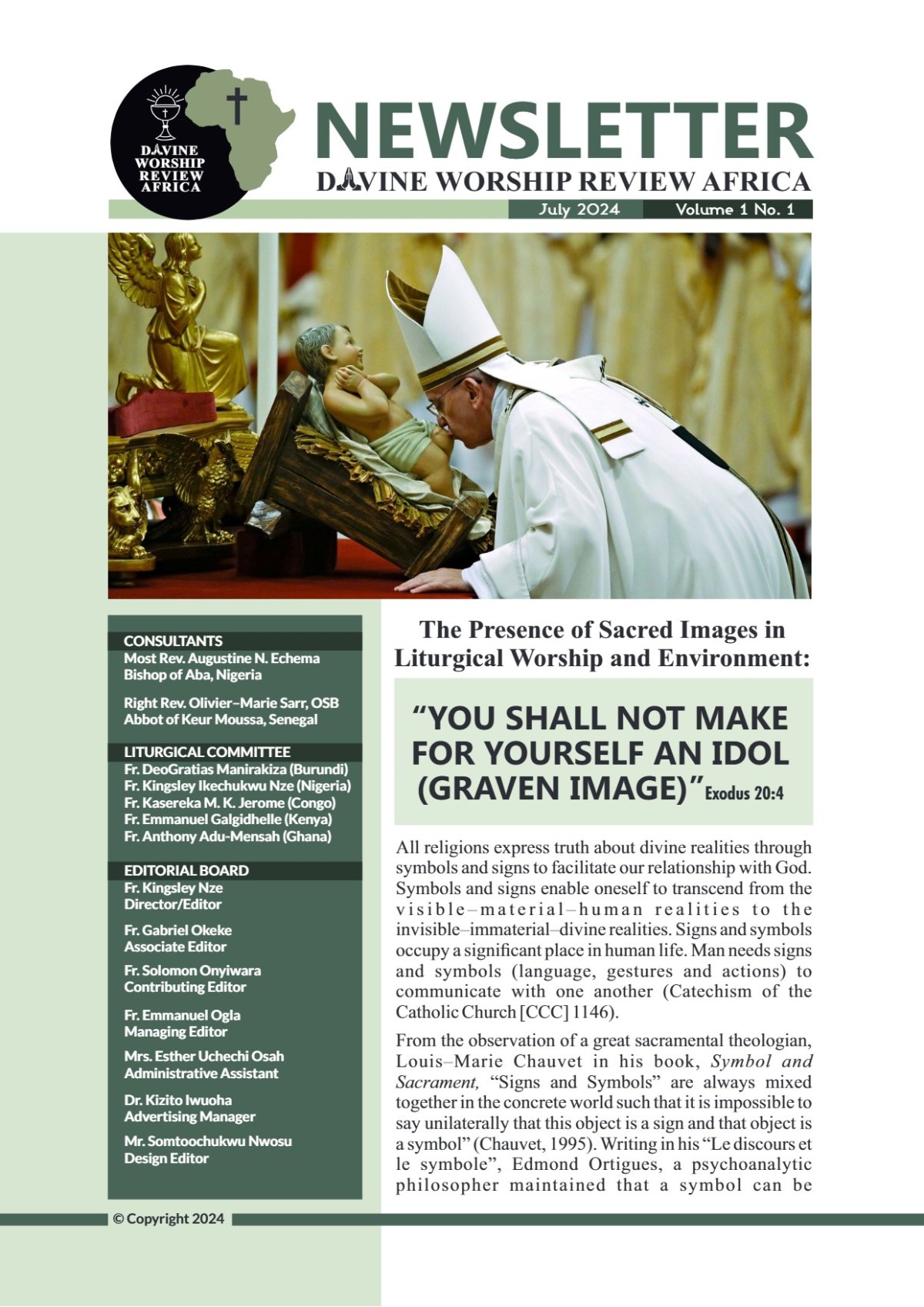
Strictly speaking, “the Christian veneration of images is not contrary to the first commandment which proscribes idols. Indeed, the honour rendered to an image passes to its prototype and whoever venerates an image venerates the person portrayed in it. The honour paid to sacred images is a respectful veneration, not the adoration due to God alone” (CCC. 2132). Religious worship is not directed to images in themselves, considered as mere things, but under their distinctive aspect as images leading us on to God incarnate. What the sacred images do is to lift our hearts to heaven for a deeper and personal contemplation on the mystery of our faith.
The veneration of images is also justified in the First Apology of St. John of Damascus against those who attack the divine images when he says: “I do not adore the creation rather than the Creator, but I adore the one who became a creature, who was formed as I was, who clothed Himself in creation without weakening or departing from His divinity, that He might raise our nature in glory and make us partakers of His divine nature”.
The Second Vatican Council Fathers in article 125 of Sacrosanctum Concilium (Constitution on the Sacred Liturgy), provided clear instruction on the positioning of sacred images in the Church and the moderation of the numbers to avoid a devotion of doubtful orthodoxy.
Veneration of sacred images is a way to honour and adore one God and Father of all, who is over all and through all and in all (cf. Eph 4:6). One fact we must never rule out is that images act as a visual aid for the people of God. We have photographs of our grandparents to remember them and share stories about who they were with other people. We have images of our leaders to honour them and preserve their memory. Jesus, Mary, Joseph and the saints are no different than any other important public figure in our world today.
Fr. Kingsley Nze, a priest of the Archdiocese of Owerri and the Director of Pastoral Affairs, holds a doctorate in Sacred Liturgy from the Pontifical University of St. Anselm Rome. He specializes in Liturgical Ecclesiology and lectures in the Seat of Wisdom Seminary Owerri, Nigeria.