
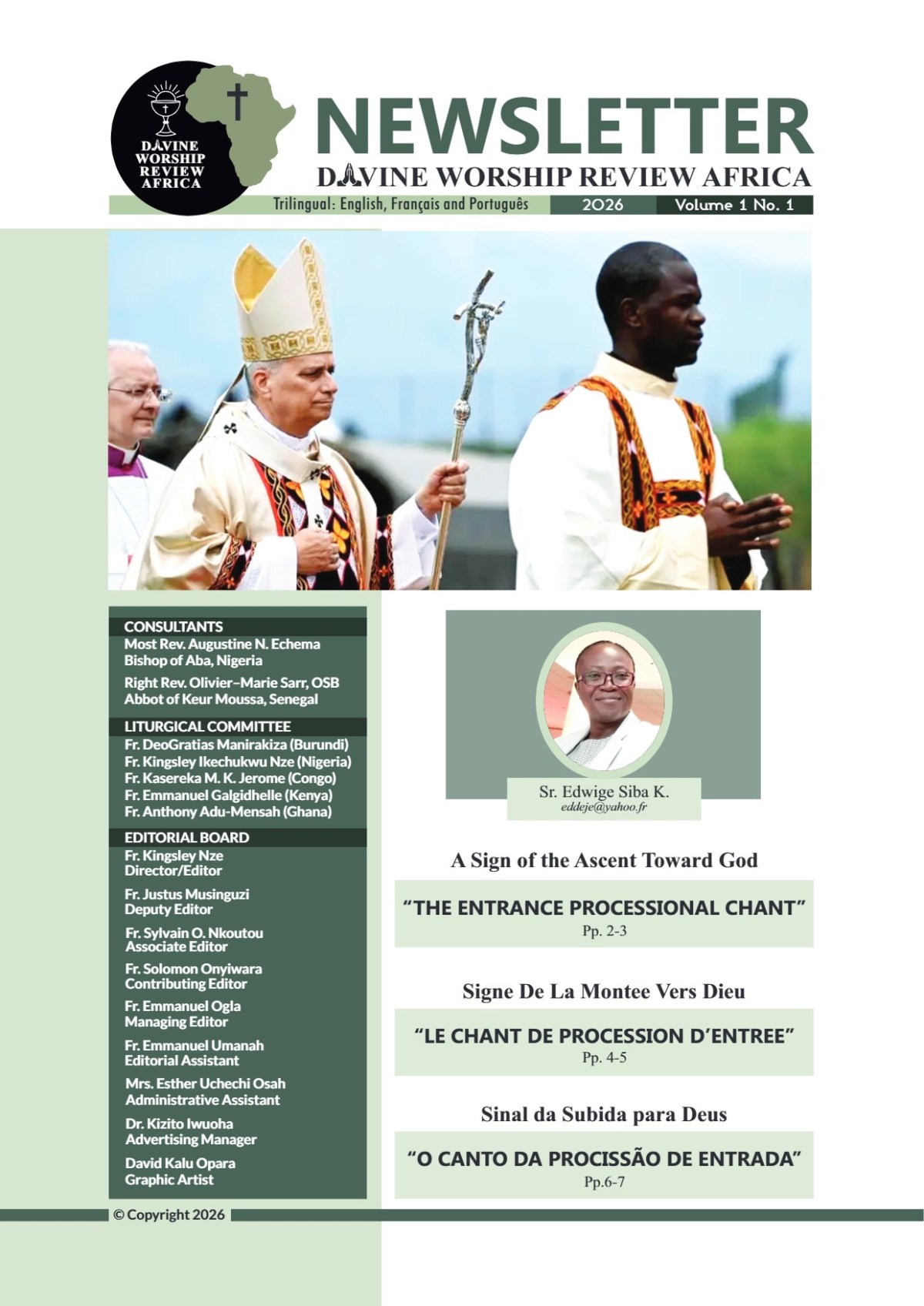
Throughout human history, music and song have accompanied the most significant as well as the ordinary moments of life. The genius of peoples in this field abundant and creative has developed a repertoire as rich in genres, forms, and musical styles as in the selection of songs for liturgical celebrations. The two previous editions explored the origin, meaning, importance, and sacred function of the entrance procession in Catholic liturgy. Here, we continue reflecting on the same subject, giving particular attention to its musical dimension.
In the liturgy, many processions are accompanied by singing. In fact, because a procession is a movement, “it contains the human gesture that serves as its fundamental expression a motion which, taken up by the spirit, is transcribed and perceived in rhythm.” Among processional chants, the entrance processional chant of the Mass stands out as the first act of the gathered people. Its liturgical meaning deserves to be rediscovered, as do its participants, its modes of execution, and its texts.
The Entrance Processional Chant: Meaning and Liturgical Role
Through the entrance processional chant, the active participation of the faithful called to fraternal communion is realized and put into practice. This chant reminds us that the life of the faithful is a pilgrimage, a celebration toward which we journey as to a holy place where God dwells. Even more, toward someone.
This sung piece not only enriches the movement of the people walking toward their Lord but also prepares them in praise to become a liturgical assembly at the moment of the celebrant’s greeting and the people’s response. However, it should be recalled that the entrance chant is not a ritual chant in the strict sense, since it does not possess value in itself like the Gloria and the Sanctus (General Instruction of the Roman Missal [GIRM] no. 37a). Like the chants for the offertory, the fraction (Agnus Dei/Lamb of God), and Communion, it accompanies the rite (GIRM no. 37b).
Moreover, its role is “to open the celebration, foster the unity of the gathered faithful, introduce their minds into the mystery of the liturgical season or feast, and accompany the procession of the priest and ministers” (GIRM no. 47).
Participants and Modes of Execution
The General Instruction of the Roman Missal (GIRM no. 47) identifies the liturgical assembly, the choir, and the cantor as the principal participants in the entrance chant.
The liturgical assembly comes first. For Abbé Pascal Acafou-Grah, a pioneer of the liturgical movement in Côte d’Ivoire, it is the primary and most fundamental liturgical reality. Therefore, this chant belongs to the assembly and is rightly called an “assembly hymn.” The chosen pieces should be suited to the technical abilities of the people.
The choir serves the people’s singing by supporting it. “The people’s song urgently calls for the role of a choir,” which provides a model, creates an atmosphere, alternates with the people, and educates them toward a careful and prayerful execution. The cantor, also called the liturgical leader, introduces and guides the people’s singing through simple gestures and intonations.
Regarding the modes of execution (GIRM no. 48), there may be alternation between choir and people, or between cantor and people; or the entire chant may be sung either by the people alone or by the choir alone when exceptional pastoral circumstances allow.
Texts for the Entrance Processional Chant
According to GIRM no. 48, one may use the antiphon with its psalm found in the Graduale Romanum, the Graduale Simplex, or in the Roman Missal. This antiphon is generally connected to the readings of the day. Consequently, the chosen chant may reflect their content while remaining consistent with the sacred action, expressing unity of hearts, gathering, and entry into God’s temple. The Songs of Ascents (Psalms 119–133) are particularly appropriate and hold a place of honor. The GIRM also allows the choice of a hymn suited to the character of the day or season, whose text has been approved by the Conference of Bishops. The Litany of the Saints is fitting as the entrance chant for the Solemnity of All Saints. The hymn Adeste Fideles would be ideal at the entrance of the Mass on Christmas Day.
Furthermore, the chosen musical form (hymn, acclamation, responsorial chant, song with refrain, litany) should enable the participation of the people and take into account the mentality of the faithful as well as the abilities of each assembly (GIRM no. 40).
Conclusion
In summary, the entrance processional chant disposes the assembly to enter into the Eucharistic celebration. This entrance is a spiritual ascent toward God who welcomes and draws us to Himself. It teaches that the liturgy is a mystical space into which we enter with faith for thanksgiving. And since this entrance into the liturgy is carried by the Holy Spirit, each member of the faithful is called to sing joyfully: “Open to me the gates of righteousness; I will enter and give thanks to the Lord” (Psalm 117:19).