
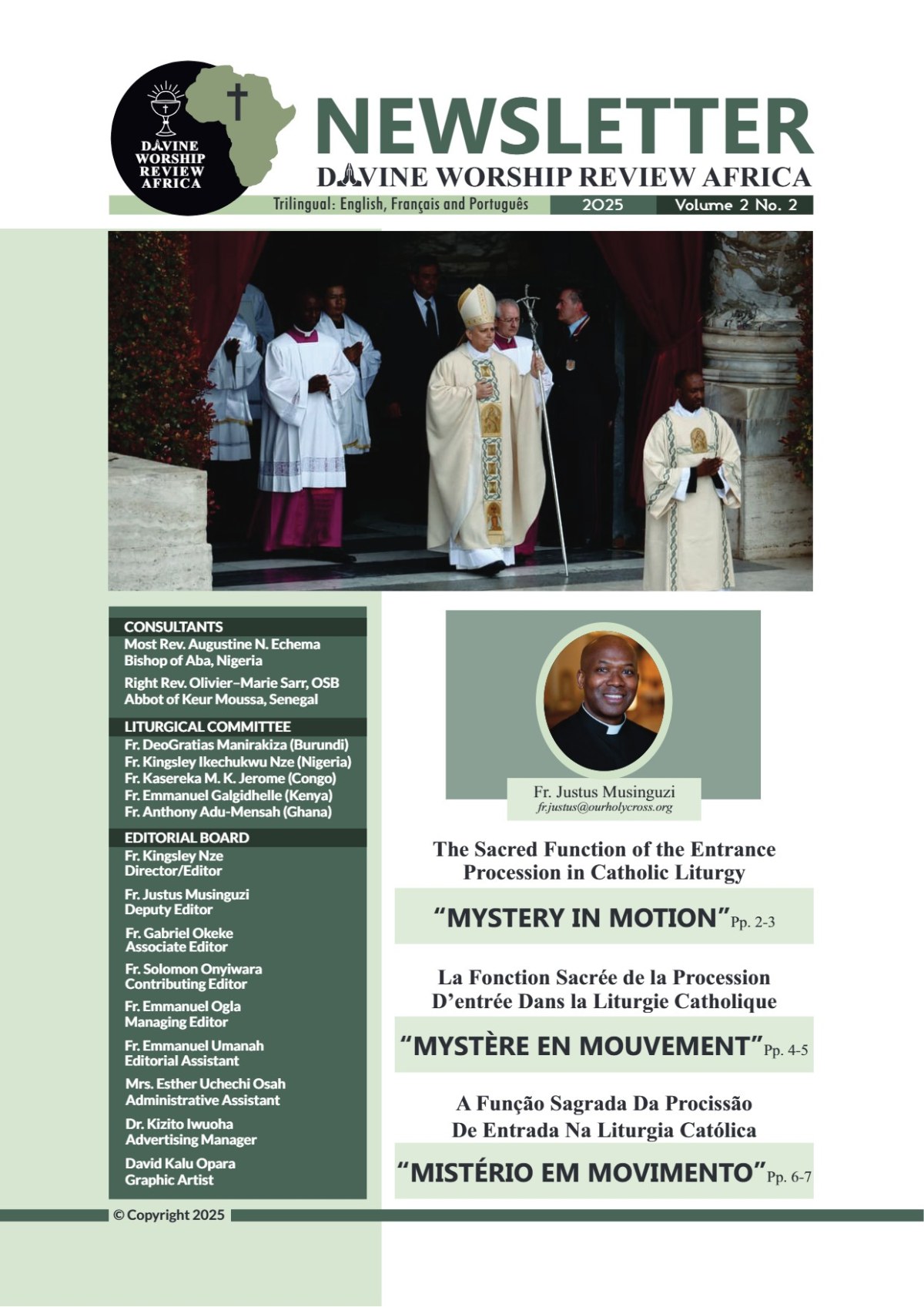
In our January edition, we explored the origin, meaning and importance of procession in the Catholic liturgy. The present edition focusses on the Entrance procession and its significance. The entrance procession in the Catholic Church serves as a crucial liturgical element, symbolizing the journey of the Church—as the pilgrim people of God—towards the heavenly Jerusalem. It is an essential act of worship that encapsulates themes of community, unity, and divine presence while marking the beginning of the Sacred Liturgy, especially during the Eucharistic celebration. This procession not only emphasizes the sacred nature of the Mass but also invites the faithful to engage actively and prayerfully in the liturgy.
The Entrance Procession is more than a ceremonial act; it is an integral part of the Mass that evolves through various signs and symbols. During this sacred event, members of the liturgical assembly are called to participate fully, consciously, and actively (Sacrosanctum Concilium 11, 14). This participation leads to an interior experience where the faithful hear the Word, witness the glory of the Holy, and engage deeply with the mystery of faith, “per ritus et preces” (Sacrosanctum Concilium 48). Through the liturgy, especially the Eucharist, grace flows abundantly, sanctifying the faithful and glorifying God (Sacrosanctum Concilium 10).
In the context of a highly concelebrated Masses—such as Ordinations, Chrism Masses, and significant diocesan, national, or international gatherings (cf. Sacrosanctum Concilium 57; IGMR no. 199; Ecclesia Semper)—it is vital to reflect on the entrance procession’s sacredness. Observing the behaviors of some priests during these moments is critical; unfortunately, there have been instances where the inherent dignity and significance of the entrance procession are undermined. Some priests engage in actions during the procession that lack decorum and reverence, reflecting what could be termed “liturgical abuses.” For instance, some priests have appeared in other attires that may look similar to an Alb instead of the appropriate Albs, while others walk in a manner that seems more fitting for a marketplace than a sacred space. Some engage in conversations, humor, and greetings while the entrance hymn is being sung, reducing a solemn moment to a casual encounter. Additionally, the presence of smartphones and late arrivals can further distract some priests from the sacredness of this moment. These actions drain the entrance procession of its essential spiritual value and the beauty it is meant to convey.
To restore and foster the liturgical significance of the entrance procession, we must view it in the broader context of the concelebrated Mass. This Mass is not merely a rite enhancing the solemnity of the Eucharist; it is a ritual expression of several unities: the unity of the Priesthood of the New Testament, the uniqueness of Christ’s sacrifice, and the unity of the People of God, especially when presided over by the Bishop together with his presbyterate and ministers (cf. Sacrosanctum Concilium 41, 57; Lumen Gentium 28; Presbyterorum Ordinis 7-8). Through the Eucharistic concelebration, the unity of the Priesthood is expressed, as all concelebrants, participating in the one priesthood of Christ, collaborate to consecrate the Eucharist and present the sacrifice of redemption. From the outset, the entrance procession of a highly concelebrated Mass should embody grace, simplicity, beauty, and order, with each concelebrant mirroring the celebrant's demeanor and reverence. This unity highlights Christ’s singular sacrifice performed by all who are assembled around the altar.
Moreover, the entrance procession illustrates the organic unity of the Church and its participation in the Eucharistic sacrifice (IGMR 199; Ecclesia Semper). The roles of every participant—whether in ministry or lay—are interwoven, fulfilling their functions in harmony, and thus entering into the sacrifice of Christ. As noted by S. Rosso in his article on processions, “as a pilgrimage, the procession ritualizes the itinerant condition of humanity.” It is a movement embodying the search for God, marked by supplications and acclamations of praise, orderly and engaging in a journey towards the temple where sacrifice and communion occur. This sentiment is echoed in the Christian entrance procession, which manifests the path of the Church towards the ultimate heavenly banquet.
The procession begins when the celebrant, concelebrants, and ministers are vested in the appropriate liturgical attire. At the Master of Ceremonies’ instruction, all participants enter a moment of recollection, signaled by a ringing bell or another designated sign, thus announcing that the sacred event is underway. As the procession unfolds, the liturgical assembly begins its formation, converting individuals into a congregation. The entrance procession visually and spiritually symbolizes a pilgrimage, representing the entire Church’s journey toward the Divine. It serves as the epiphany of the pilgrim Church, a gathering of believers preparing for sacramental encounter with the Triune God. Particular attention should be given to the choice and selection of the Entrance hymn knowing that its purpose is to “open the celebration, foster the unity of those who have been gathered, introduce their thoughts to the mystery of the liturgical season or festivity, and accompany the procession of the priest and the ministers” (GIRM 47; 121; 172). Hence, it should reflect the celebration of the day and the liturgical season (cf. Dies Domini 50; Musicam Sacram 9) in accordance with the principle of lex orandi lex credendi. However, “if there is no singing at the entrance, the antiphon in the Missal is recited.” (GIRM 48).
To conclude, it is essential for all priests to recognize their identity and purpose during the entrance procession, understanding they act in persona Christi and persona Ecclesiae. As in the encounter of the risen Lord with the disciples on the road to Emmaus, Christ is present among us during this sacred moment (Luke 24:15). The Church is not self-created; it exists by divine calling through Christ's ministry in the Holy Spirit (cf. Lumen Gentium 1-8). The entrance procession is a coming together of the faithful, drawing closer to the Risen Christ and entering into a Eucharistic assembly.
In accordance with the General Instruction of the Roman Missal 2002 and Directives on the Rite of Concelebration, it is prohibited for anyone to join a concelebration once the Mass has begun (IGMR 2002, no. 206). The directives emphasize that all concelebrants must wear the prescribed liturgical vestments to uphold the reverence and decorum due to this sacramental act. The Sacred Congregation of Rites, in its declaration on the celebration of concelebration, cautions bishops and superiors to ensure that these gatherings reflect genuine reverence and propriety. Together, we should strive for a deeper understanding and commitment to the spiritual, theological, and liturgical significance inherent in every aspect of the Mass as an action of the Whole Christ—Head and Members.
Fr. Justus Musinguzi is a Ugandan ordained for the Catholic diocese of Butare in Rwanda. He holds doctorate degrees in Sacred Liturgy and Dogmatic Theology, from the Pontifical University of St. Anselm Rome. Currently, he is the Parochial Vicar at Holy Cross Parish Northeast Minneapolis.